1. Achievement Title
Locusts adopt IP3 as a second messenger for olfactory signal transduction
2. Achievement Summary
For the first time experimentally demonstrated that insect olfactory signal transduction does not rely on GPCR, with IP3 serving as the second messenger.
3. Research Team and Detailed Achievement Description
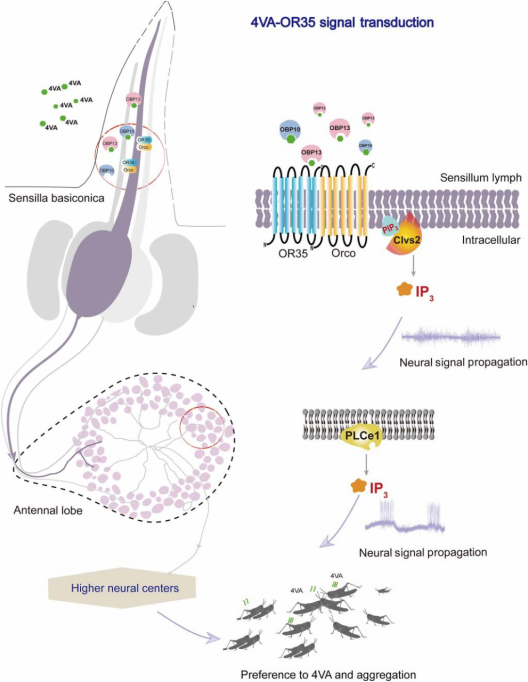
On September 11, 2025, the Kang Le team published their latest research findings in the internationally renowned journalScience Advances titled “Locusts adopt IP3 as a second messenger for olfactory signal transduction”. Using the olfactory perception of the aggregation pheromone 4-vinylanisole (4VA) as a model, the team systematically analyzed the complete olfactory signaling pathway from 4VA entry into the locust antenna to activation of the antennal lobe central nervous system and behavioral response. The study found that 4VA is first recognized and transported by two odorant-binding proteins (OBP10 and OBP13) in the antenna, activating the specific receptor OR35 and co-receptor Orco to form a complex. However, this complex does not rely on the traditional GPCR mechanism; instead, it regulates the transport of membrane lipid PIP2 through a lipid-binding protein named Clvs2, thereby promoting the synthesis of the key signaling molecule IP3. Subsequently generated IP3 induces the production of neural electrical signals in the antenna, transmits along the olfactory nerve to the antennal lobe of the brain, activates the enzyme PLCe1 to further amplify the IP3 signal, completing the transduction of olfactory signals in the central nervous system. As a core second messenger, IP3 enables the conversion of odor signals to neural signals in the antennal lobe of the locust brain, ultimately triggering behavioral responses. This study not only identified a key new component in the insect olfactory signaling pathway but also revealed the mechanism of IP3 action in non-GPCR olfactory receptors, demonstrating the uniqueness and complexity of the insect olfactory system. For the first time experimentally demonstrated that insect olfactory signal transduction does not rely on GPCR, with IP3 serving as the second messenger. This research provides important theoretical foundations for a deeper understanding of insect olfactory behavioral regulation mechanisms and for designing novel green pest control strategies based on interference with pheromone perception. Academician Kang Le served as the corresponding author.
4. Link to the Original Article
https://www.science.org/doi/10.1126/sciadv.ads1352
5. Achievement Schematic Diagram