1. Achievement Title
GAF-dependent Chromatin Plasticity Determines Promoter Usage to Mediate Locust Gregarious Behavior.
2. Achievement Summary
Transcription factor GAF cooperates with multiple binding sites to regulate chromatin accessibility and select promoter transcription, thereby determining gregarious behavior in migratory locusts
3. Research Team and Detailed Achievement Description
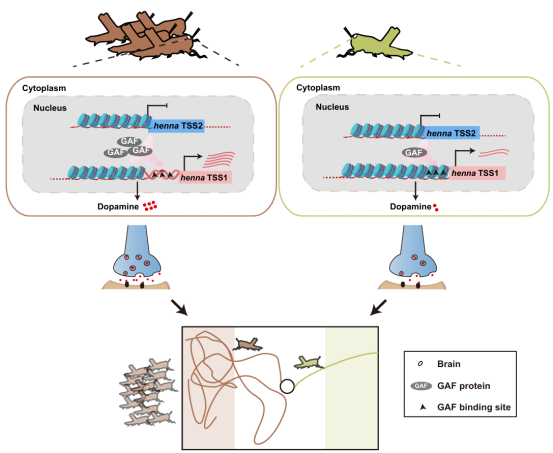
On April 7, 2025, the Kang Le team from the Faculty of Synthetic Biology at Shenzhen University of Advanced Technology published a research paper in the internationally renowned journalEMBO Journal titled “GAF-dependent Chromatin Plasticity Determines Promoter Usage to Mediate Locust Gregarious Behavior”, revealing the epigenetic regulatory mechanisms of phenotypic plasticity from a chromatin structural perspective. Using DNase-seq omics technology, the work revealed chromatin accessibility changes during phase transition in migratory locusts, discovering that the transcription factor GAGA factor (GAF) rapidly responds to external signals, reshapes chromatin accessibility through synergistic action of multiple functionally distinct DNA binding sites in the promoter region, and drives the transcription initiation process.
The migratory locust, due to its ability to reversibly switch between gregarious and solitary phases in response to density changes, has become an important model system for studying phenotypic plasticity in insects. Through long-term research, the Kang Le team identified the central role of the dopamine synthesis pathway in the central nervous system in regulating behavioral plasticity in migratory locusts. However, the mechanism by which the dopamine synthesis process rapidly and flexibly enables the quick transition of migratory locusts in response to population density signals remained unclear. Through a series of experiments, the study identified key steps in the transcriptional regulation of the core phenylalanine hydroxylase gene henna in the dopamine synthesis pathway, revealing that the phenotype-associated key transcription factor GAF rapidly regulates chromatin accessibility, thereby controlling the transcriptional initiation of the alternative promoter of henna. The study further revealed that even multiple GAF binding sites within the same promoter exhibit functional division of labor, with some enhancing transcription and others promoting chromatin accessibility. This pre-transcriptional epigenetic regulatory process, in which GAF cooperates with multiple binding sites, lays the foundation for the rapid initiation of coordinated gregarious behavior in migratory locusts under high population density. The study proposed a novel epigenetic regulatory mechanism for short-term adaptation of insect behavior, demonstrating the pattern of “transcription factor multi-site cooperation → chromatin accessibility regulation → initiation of core gene transcription”, highlighting the complexity and precision of chromatin dynamics in gene expression regulation. This research provides a new perspective for understanding the dynamic adaptation mechanisms of insects to environmental signals and offers a theoretical basis for developing novel pest control strategies. Academician Kang Le from Shenzhen University of Advanced Technology served as the corresponding author, while PhD student Li Xiao and Researcher Jiang Feng from the Institute of Zoology, Chinese Academy of Sciences, are co-first authors of this study.
4. Link to the Original Article

5. Achievement Schematic Diagram