1. Achievement Title
Decoding 4-vinylanisole biosynthesis and pivotal enzymes in locusts
2. Achievement Summary
First systematic elucidation of the biosynthetic pathway of the locust aggregation pheromone 4-Vinylanisole (4VA), identification of key enzymes, and development of small-molecule inhibitors, enabling precise regulation of locust aggregation behavior and opening a new path for green pest control.
3. Detailed Introduction to the Research Team and Achievements
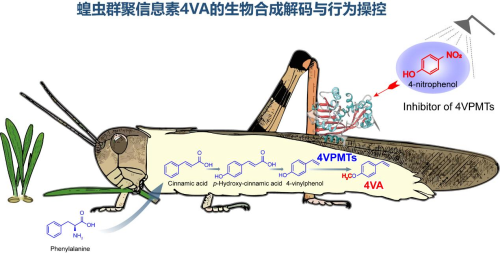
On June 25, 2025, the collaborative research results of the Kang Le team from Shenzhen University of Advanced Technology and the Lei Xiaoguang team from Peking University were published online in the international top-tier academic journalNature. This study successfully decoded the biosynthetic mechanism of the locust aggregation pheromone 4-vinylanisole (4VA) and achieved artificial intervention in locust aggregation behavior, bringing new breakthroughs to green pest control in agriculture. Insect pheromones play a crucial role in regulating insect behavior, yet complete elucidation of the biosynthetic pathways of specific pheromones remains rare. In 2020, the Kang Le team confirmed that 4VA is the aggregation pheromone of the migratory locust; this collaboration further explored the 4VA biosynthetic pathway in depth. The researchers determined that the biosynthetic substrate of 4VA is plant-derived phenylalanine. Through feeding or injection of stable isotope-labeled candidate intermediates, the 4VA biosynthetic pathway was clearly delineated: Phenylalanine is sequentially converted through cinnamic acid, p-hydroxycinnamic acid, and 4-vinylphenol to ultimately yield 4VA, with some conversion steps utilizing plant-derived intermediates, demonstrating the locust’s highly efficient and energy-saving biosynthetic strategy. The study further revealed that the key difference in 4VA synthesis between gregarious and solitary migratory locusts lies in the conversion from 4-vinylphenol (4VP) to 4VA, controlled by methyltransferases 4VPMT1 and 4VPMT2, which serve as molecular switches for 4VA biosynthesis, with their expression influenced by population density. By resolving the crystal structure of the 4VPMT2-4VP-SAM ternary complex and conducting related experiments, the substrate-enzyme binding mechanism was clarified. Based on these findings, the research team designed and screened the small-molecule inhibitor 4-nitrophenol (4NP). 4NP inhibits 4VPMT1 and 4VPMT2 at very low concentrations by competitively binding to the enzyme active sites, thereby blocking 4VA synthesis. Experiments demonstrated that 4NP significantly reduces 4VA release in locusts, inducing a behavioral shift from gregarious to solitary phase, and also suppresses aggregation in solitary locusts under crowding conditions. This study deeply revealed the molecular mechanisms of insect chemical communication, providing a novel strategy for pest control independent of traditional chemical pesticides, promoting the shift toward precise and green pest management modes, and holding significant importance for safeguarding food security and ecological environments. Guo Xiaojiao from the Institute of Zoology, Chinese Academy of Sciences, Gao Lei from Peking University, and PhD student Li Shiwei from the Institute of Zoology, Chinese Academy of Sciences, are co-first authors; Academician Kang Le from Shenzhen University of Advanced Technology and Lei Xiaoguang from Peking University are co-corresponding authors. Numerous researchers participated in the study, which was supported by projects from the National Natural Science Foundation of China, the National Key Research and Development Program of China, and the New Cornerstone Science Foundation, among others.
4. Link to the Original Article
Article Link DOI: 10.1038/s41586-025-09110-y
5. Achievement Schematic Diagram