1. Achievement Title
Locusts employ neuronal sensory prioritization to reconcile two conflicting olfactory signals while aggregating
2. Achievement Summary
Revealed how migratory locusts achieve a balance between group aggregation, predator defense, and avoidance of intraspecific cannibalism through exquisite tuning of two functionally opposing chemical signals, 4VA and PAN, during the gregarious process.
3. Detailed Introduction to the Research Team and Achievements
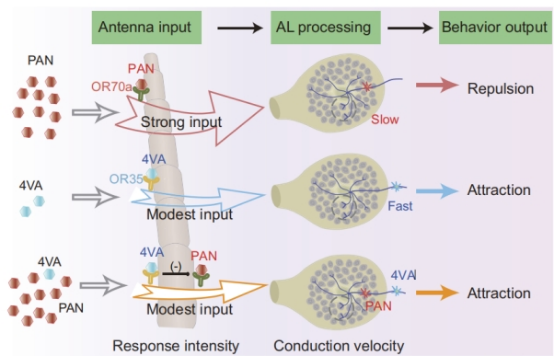
On August 13, 2025, the Kang Le team from Shenzhen University of Advanced Technology published their research findings in the internationally renowned journalProceedings of the National Academy of Sciences (PNAS). During aggregation, the migratory locust (Locusta migratoria) releases two key odor molecules: 4-vinylanisole (4VA) as an aggregation pheromone, attracting conspecifics to form locust swarms; phenylacetonitrile (PAN) as an alarm signal and precursor to defensive toxins, preventing intraspecific cannibalism and repelling predators. However, how locusts coordinate these two conflicting olfactory signals during aggregation remained unclear. This study addressed the issue by investigating the release dynamics, behavioral effects, and underlying neural mechanisms of these two signals. The study found that 4VA release precedes PAN, with lower locust density required to trigger 4VA release; as aggregation progresses, PAN release gradually increases. Although PAN’s final release level exceeds that of 4VA, locusts consistently show preference for the mixed odor regardless of the ratio or concentration. Notably, adding an appropriate amount of 4VA to PAN counteracts its repulsive effect, but adding PAN to 4VA does not produce this effect. At the mechanistic level, the study found that antennal neurons responsive to 4VA inhibit the activity of neurons responsive to PAN. In the antennal lobe, the conduction velocity of projection neurons (rather than other neural characteristics) dominates the observed behavioral patterns, ultimately producing an attractive response. This study systematically revealed for the first time how migratory locusts coordinate two functionally opposing pheromones to achieve intragroup cooperation and individual defense. It not only resolves the ecological puzzle of how locusts “balance aggregation and defense” but also provides a new research paradigm for understanding how animals cope with multisource sensory information. This work holds significant reference and inspirational value in fields such as ecological behavioral regulation, pest behavioral manipulation (e.g., locust plague control), and artificial intelligence decision modeling.
4. Link to the Original Article
https://doi.org/10.1073/pnas.2501490122
5. Achievement Schematic Diagram